
Anthropic Just Launched Opus 4.7 — and a Secret Cyber Model Few Will Ever Access
Anthropic has had a busy April. On April 16, the company launched Claude Opus 4.7 — its most capable publicly available model to date — while also revealing more details about Claude Mythos Preview, a more powerful model it's keeping under tight lock and key. The two releases tell a story about where AI is heading: more capable, more specialized, and more carefully rationed.
Anthropic Just Launched Opus 4.7 — and a Secret Cyber Model Few Will Ever Access
Anthropic's latest wave of releases includes a powerful new general model, a cybersecurity-focused AI restricted to 11 organizations, and a design tool that turns Claude into a visual collaborator.
AI & Machine Learning · 4 min read
Anthropic has had a busy April. On April 16, the company launched Claude Opus 4.7 — its most capable publicly available model to date — while also revealing more details about Claude Mythos Preview, a more powerful model it's keeping under tight lock and key. The two releases tell a story about where AI is heading: more capable, more specialized, and more carefully rationed.
Opus 4.7: Better at Coding, Smarter at Reasoning
Opus 4.7 is Anthropic's new flagship for everyday use. According to the company, it outperforms its predecessor, Opus 4.6, on agentic coding, multidisciplinary reasoning, complex tool use, and computer-use tasks. In other words: it's faster at writing and debugging code, better at following multi-step instructions, and more reliable when given tools to interact with real software.
The model launched at the same price as Opus 4.6 — $5 per million input tokens and $25 per million output tokens — which means existing users get a meaningful upgrade without a cost bump. Opus 4.7 is available through the Claude API, though it includes breaking changes versus Opus 4.6, so developers should review the migration guide before upgrading.
One notable addition: Anthropic said it built in safeguards that automatically detect and block high-risk cybersecurity requests, a sign the company is trying to draw a clear line between legitimate developer use and potential misuse.
Claude Mythos: The Model Anthropic Won't Release to the Public
Running parallel to Opus 4.7 is something more unusual. On April 7, Anthropic announced a preview of Claude Mythos — internally called "Project Glasswing" — made available to just 11 companies and organizations to find and fix cybersecurity vulnerabilities.
Mythos is described as more powerful than Opus 4.7, but Anthropic has no plans to release it broadly. The UK AI Security Institute reported that Claude Mythos was able to solve a 32-step cyber range called "The Last Ones" 3 out of 10 times, making it the first model to do so end-to-end. The next closest models were Opus 4.6 and two versions of OpenAI's GPT-5.
The controlled rollout reflects Anthropic's long-standing stance on safety: some capabilities are too risky to hand out freely. What the company learns from Mythos's real-world deployment, it says, will inform its eventual goal of a broader release of Mythos-class models.
Claude Design: A New Tool for Visual Collaboration
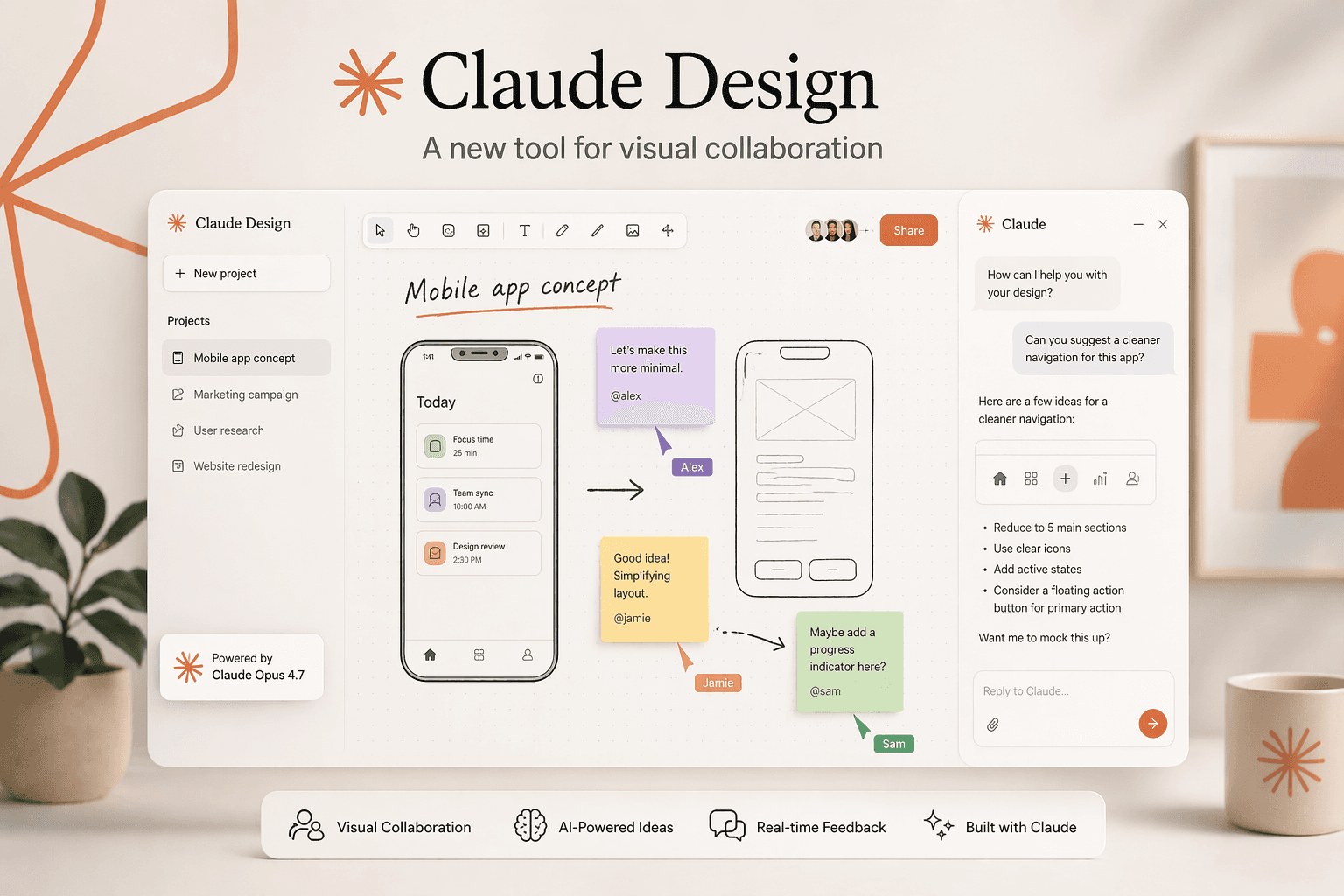
Alongside the model releases, Anthropic launched Claude Design — a new product from Anthropic Labs. Claude Design lets you collaborate with Claude to create visual outputs like designs, prototypes, slides, and one-pagers. It's positioned as a creative partner rather than just a text generator, expanding Claude's reach beyond code and writing into visual work.
The product is still in early stages, but it signals Anthropic's intent to compete in a space currently dominated by tools like Canva's AI features and Adobe Firefly.
What Else Shipped This Month
The model launches aren't happening in isolation. Anthropic also introduced data residency controls, letting API users specify where model inference runs geographically — a feature enterprise customers have been requesting for compliance reasons. Claude for Excel is now available in beta to all Max, Team, and Enterprise users, adding support for pivot tables, charts, and file uploads.
And for developers building long-context applications, the 1M token context window is now available in beta for Claude Opus 4.6, in addition to Sonnet 4.5 and Sonnet 4.
Anthropic is moving fast — but the Mythos situation shows it's also thinking carefully about what it releases and to whom. Whether that selective approach holds as competitive pressure mounts is the real question.
Tags: Anthropic, Claude, Opus 4.7, Claude Mythos, AI safety, Claude Design, generative AI